The following provides information about entering vacation data in the vacation accounting (Settings/Time tracking/Vacation accounting) of a person.
Vacation entitlement
Proration
Vacation accrual
Tiered vacation entitlement
Vacation expiration/statute of limitations and expiration date
VACATION ENTITLEMENT
Vacation year and crediting date of the annual entitlement
In Austria, there are the following variants regarding the definition of the vacation year (= the point in time at which a vacation year is settled, remaining vacation days expire, or a new allotment is assigned).
- Vacation by calendar year: new vacation entitlement arises on 01/01.
- Vacation by hire date: new vacation entitlement arises on the anniversary of the hire date
- Vacation by fiscal year: here the new vacation entitlement arises after the end of the fiscal year, e.g., 04/01 for all employees
- is settled like vacation by hire date, i.e., there is no distinction between the first / second half of the year at hire
Switching from one definition of the vacation year to another is possible in principle, but has far-reaching effects on the respective vacation entitlement of the employee. See also: https://www.wko.at/arbeitsrecht/urlaubsjahr
Where is the crediting date entered?
In the person's master record, go to the tab Settings → Time tracking → Vacation accounting
The respective entry is made in the field "Crediting of the annual entitlement".
This defines the day of the year on which the vacation entitlement is credited to the remaining vacation account. This setting also affects the behavior of the option "Proration in the year of hire". In addition, this cut-off date is also used to credit the entitlement for care leave/special leave.
- Vacation by calendar year
- Parameter "Crediting of the annual entitlement": Calendar year
- Vacation by hire date
- Parameter "Crediting of the annual entitlement": Hire date
- Vacation by fiscal year
- Parameter "Crediting of the annual entitlement": can actually be left empty, since it is overridden by the parameter "Alternative crediting cut-off date"
- Parameter "Alternative crediting cut-off date": Fiscal Fiscal year cut-off date of the company
It is absolutely necessary to make a selection for the crediting date in order to guarantee a vacation entitlement at all! If no selection is made, no vacation is credited!
Scope and type of entitlement (in days or hours)
Here you enter the vacation entitlement, and whether it is specified in days or hours, that the employee is entitled to in a full year.
|
Value
|
Unit
|
|
Numeric value
|
Days/hours per year
|
Special entitlement
Here you can enter the special leave entitlement per year for the person concerned. These special leave days are used, for example, in the case of a wedding, moving, a death in the family or the birth of a child.
|
Value
|
Unit
|
|
Numeric value
|
Days/hours per year
|
PRORATION
Note! Proration is only possible if the vacation entitlement is recorded in DAYS!
Proration is not possible for a vacation entitlement in hours!
You can find information on proration for part-time employees HERE
Proration in the year of hire
The following information is based on https://www.usp.gv.at/mitarbeiter/urlaub/urlaubsanspruch-und-urlaubsausmass.html
For the proration at hire to be carried out, a selection must be made under the tab Settings → Time tracking → Vacation accounting → Proration of the year of hire
In principle, a distinction must be made as to whether the hire took place in the first the first half of the year year (01/01 – 06/30) or in the second the second half of the year year (07/01 – 12/31).
Hire in the first half of the year (01/01 – 06/30)
The complete vacation entitlement is distributed proportionally over the first six months using the following formula.
(Vacation entitlement / number of days in the year) * days from hire date = current vacation entitlement rounded up to whole days
In the sixth month, the remaining vacation entitlement is credited to the remaining vacation account.
Hire in the second half of the year (07/01 – 12/31)
In this case, the entitlement is prorated first. Then the vacation is divided over the first six months between the current and the new vacation year and credited:
1. First, the vacation entitlement is calculated on a prorated basis:
(Vacation entitlement / number of days in the year) * (12/31 – hire date) = prorated vacation entitlement [rounded up to whole days]
2. Division of the vacation entitlement in the first six months until 12/31
The vacation entitlement is credited to the remaining vacation account according to the following formula:
(Vacation entitlement / number of days in the year) * days from hire date = current vacation entitlement [rounded up to whole days]
In the sixth month, the remaining vacation entitlement is credited to the remaining vacation account.
3. At the beginning of the new vacation year, the vacation entitlement is credited as of the last day of the month until the six months are reached:
(full vacation entitlement / number of days in the year) * days from 01/01 = current vacation entitlement [rounded up to whole days]
Examples:
Year of hire:
If the vacation is credited as of the hire date anniversary, the first 6 months can also extend beyond a a calendar year.
- Calculation:
- Basis for the vacation entitlement: 25 days (for full-time and 5 workdays)
- First 6 months: prorated, and afterward the full vacation entitlement
- Formula: 25 / 365 * days from hire
- Example:
- Month 1: 25 25 / 365 * 31 = 2.12... ==> 3 days of vacation entitlement (always rounded up)
- Month 2: 25 / 365 * 61 = 4.17... ==> 5 days (3 days credited in the first month, therefore 2 days in month 2) ==> 5 - 3 = 2
- Month 3: 25 / 365 * 92 = 6.30.. ==> 7 days ==> 7 - 3 - 2 = 2
Calendar year:
-
First half of the year:
- Basis for the vacation entitlement: 25 days (for full-time and 5 workdays)
- First 6 months: prorated, and afterward the full vacation entitlement
- Formula: 25 / 365 * days from hire
- Example:
- Month 1: 25 25 / 365 * 31 = 2.12... ==> 3 days of vacation entitlement (always rounded up)
- Month 2: 25 / 365 * 61 = 4.17... ==> 5 days (3 days credited in the first month, therefore 2 days in month 2) ==> 5 - 3 = 2
- Month 3: 25 / 365 * 92 = 6.30.. ==> 7 days ==> 7 - 3 - 2 = 2
-
Second half of the year:
- Basis for vacation entitlement: 25 25 / 365 * remaining days in the year from hire date
- Example: 25 / 365 * 120 = 8.21... ==> this becomes 9 days, since we round up
- First 6 months prorated, until 1/1 ==> then there is a new full entitlement
- Formula: Prorated vacation entitlement / 365 * days from hire date
- Example: 9 / 365 * 31 ==> 0.76... ==> has 1 day of vacation entitlement after one month (always rounded up)
- NOTE:
- Until the new calendar year is reached, the prorated vacation entitlement is distributed over the remaining months
- Once the new calendar year is reached, the new basis for the proration is the full vacation entitlement, and proration continues until the first 6 months are reached
- Thus, in the new vacation year, the formula from the first half of the year applies again
Proration upon termination or for absence reasons such as parental leave
Note: for the termination calculation to be recognized in time by payroll, the parameter should be set promptly. It must be in the system at the latest one month before termination. On the termination day it is definitely too late. .
If the employee leaves, the entitlement in the year of termination is also reduced.
To ensure this, there is the checkbox "Proration upon termination and parental leave". This checkbox is deactivated in the default setting.
If such a proration is applied in the organization, the checkmark must be set here!
It is generally recommended to activate the automatic proration, because this way the vacation proration is carried out immediately after entering a termination date. The reduced vacation allotment is immediately shown in the correction client/day view of this person.
(Vacation entitlement / days in the year * days from start of vacation year to termination date) = new entitlement [result is not rounded!]
Proration for absence reasons such as: parental leave
Here too, activating the checkbox checkbox "Proration upon termination and parental leave" has an effect.
As soon as the corresponding absences are entered for the employee (exclusively via 'from - to date' and not via a subsequent absence reason), the days without the absence reason are determined for the respective vacation year.
The vacation entitlement for this year is then reduced using the following formula:
(Vacation entitlement / days in the year * days without absence reason in the respective vacation year) = new entitlement [result is rounded up]
The type of vacation accounting is also an influencing factor here; it is determined under under "Crediting cut-off date":
- With "VA by calendar year", 01/01 of the year counts for the calculation of the vacation entitlement
- With "VA by hire date", the exact hire date counts for the calculation of the vacation entitlement
|
Parameter in Personalwolke
|
Description
|
|
No
|
VA by calendar year: no proration for hire during the year, vacation entitlement only from the start of the next calendar year
VA by hire date: no proration, the entire annual entitlement is credited on the hire date
|
|
Legally compliant (Austria)
|
Hire in the first half of the year (01/01 – 06/30)
The complete vacation entitlement is distributed proportionally over the first six months using the following formula.
(Vacation entitlement / number of days in the year) * days from hire date = current vacation entitlement [rounded up to whole days]
In the sixth month, the remaining vacation entitlement is credited to the remaining vacation account.
Hire in the second half of the year (07/01 – 12/31)
In this case, the entitlement is prorated first. Then the vacation is divided over the first six months between the current and the new vacation year and credited:
1. First, the vacation entitlement is calculated on a prorated basis:
(Vacation entitlement / number of days in the year) * (12/31 – hire date) = prorated vacation entitlement [rounded up to whole days]
2. Division of the vacation entitlement in the first six months until 12/31
The vacation entitlement is credited to the remaining vacation account according to the following formula:
(Vacation entitlement / number of days in the year) * days from hire date = current vacation entitlement [rounded up to whole days]
In the sixth month, the remaining vacation entitlement is credited to the remaining vacation account.
3. At the beginning of the new vacation year, the vacation entitlement is credited as of the last day of the month until the six months are reached:
(full vacation entitlement / number of days in the year) * days from 01/01 = current vacation entitlement [rounded up to whole days]
|
|
Prorated
|
Hire in the first half of the year (01/01 – 06/30)
In this variant, the vacation entitlement is always prorated, unless the hire takes place on 1/1 of the year.
- First, the vacation entitlement is calculated on a prorated basis:
(Vacation entitlement / number of days in the year) * (12/31 - hire date) = prorated prorated vacation entitlement [rounded up to whole days]
-
Division of the vacation entitlement in the first 6 months months
As of the last day of the month, the vacation entitlement is credited to the remaining vacation account according to the following formula:
(Vacation entitlement / number of days in the year) * days from hire date = current vacation entitlement [rounded up to whole days]
In the sixth month, the the remaining vacation entitlement is credited to the remaining vacation account.
Hire in the second half of the year (07/01 – 12/31)
In this case too, the entitlement is prorated first. Then the vacation is divided over the first six months between the current and the new vacation year and credited:
- First, the vacation entitlement is calculated on a prorated basis:
(Vacation entitlement / number of days in the year) * (12/31 - hire date) = prorated prorated vacation entitlement rounded up to whole days
-
Division of the vacation entitlement in the first 6 months until 12/31
As of the last day of the month, the vacation entitlement is credited to the remaining vacation account according to the following formula:
(Vacation entitlement / number of days in the year) * days from hire date = current vacation entitlement [rounded up to whole days]
In the sixth month, the the remaining vacation entitlement is credited to the remaining vacation account.
-
At the beginning of the new vacation year, the vacation entitlement is credited until the six months are reached as of the last day of the month:
(full vacation entitlement / number of days in the year) * days from 1/1 = current vacation entitlement [rounded up to whole days]
In the sixth month, the the remaining vacation entitlement is credited to the remaining vacation account.
|
|
Prorated part-time
|
Is usually only relevant for municipalities.
Here the remaining vacation is automatically prorated when the weekly hours change. The remaining vacation vacation
- increases if the weekly hours increase
- decreases if the weekly hours decrease
|
Proration when changing time models models
If an employee changes the time model and the number of workdays changes as a result, the following accounts are converted based on the old workdays and the new workdays:
-
Current entitlement / current number of workdays * new number of workdays = new entitlement entitlement
-
Remaining vacation current year / current number of workdays * new number of workdays = new remaining vacation current year year
-
Remaining vacation previous year / current number of workdays * new number of workdays = new remaining vacation previous year year
-
Remaining vacation year before previous / current number of workdays * new number of workdays = new remaining vacation year before previous previous
|
Parameter in Personalwolke
|
Description
|
|
No
|
No proration
|
|
Part-time according to weekly hours in the weekly schedule schedule
|
Calculation identical to the parameter from the table above, "Prorated part-time"
|
|
Part-time according to workdays in the weekly schedule schedule
|
The calculation is composed of the formulas from "Proration upon termination" and "Proration for absence reasons such as parental leave".
|
|
Part-time factor factor
|
Calculation identical to the parameter from the table above, "Prorated part-time"
|
Note: If an employee switches to part-time, NO change to the number of days is to be made in the field "Entitlement (annual)" in Settings/Time tracking/Vacation accounting. As soon as "Part-time...." has been selected in the field "Proration of the entitlement for part-time employees?", the program calculates the correct entitlement value automatically!
Proration of the entitlement for part-time employees
Due to its scope, you will find the information in a separate chapter titled Prorated Vacation for Part-Time Employees.
VACATION ACCRUAL
Rounding parameter for vacation accrual
This determines which method is used to calculate the proration of an employee's remaining vacation.
"Shadow account"
A prorated remaining vacation balance is needed for the vacation accrual. The system provides a "shadow account" on which a termination proration is performed for every day in the past. A A parameter can be used to define for the employee whether the result should be rounded or not.
|
Option
|
Description
|
|
Day/rounded up (default)
|
The vacation is calculated exactly according to the number of days and rounded up
|
|
Days/unrounded
|
The vacation is calculated exactly according to the number of days and rounded down
|
|
Month/unrounded
|
The vacation is calculated based on the remaining months in the company and rounded down
|
Calculation: Vacation accrual as of the end of the fiscal year (usually 12/31)
For the correct rounding of vacation accruals, "Days/unrounded" must be selected under the tab Settings → Time tracking → Vacation accounting →
Rounding parameter for vacation accrual .
The value can only be queried retroactively!
Formulas:
- Step 1: Vacation entitlement full vacation year / 366 * days in the vacation year = prorated vacation entitlement
- Step 2: Remaining vacation current year as of 12/31 – vacation entitlement full vacation year + prorated vacation entitlement = remaining vacation current year prorated
- Step 3: Remaining vacation current year prorated + remaining vacation previous year + remaining vacation year before previous = total remaining vacation prorated
Example:
- Crediting of new vacation entitlement as of 10/23: 25 days
- Remaining vacation previous year as of 10/23: 9 days
- Vacation taken in the vacation year (since 10/23) = 9 days
- Total remaining vacation as of 12/31: 34 - 9 = 25 days
- 25 / 366 * 70 = 4.7814… = prorated entitlement as of 12/31
- 25 - 25 + 4.78 = 4.78 = remaining vacation current year prorated
- 4.78 + 0 + 0 = 4.78 = total remaining vacation prorated as of 12/31
The following formula allows you to perform the remaining vacation calculation in Excel:
Formel Resturlaub aliquot.xlsx
TIERED VACATION ENTITLEMENT
The following parameters (marked in red) are relevant for this in Personalwolke.
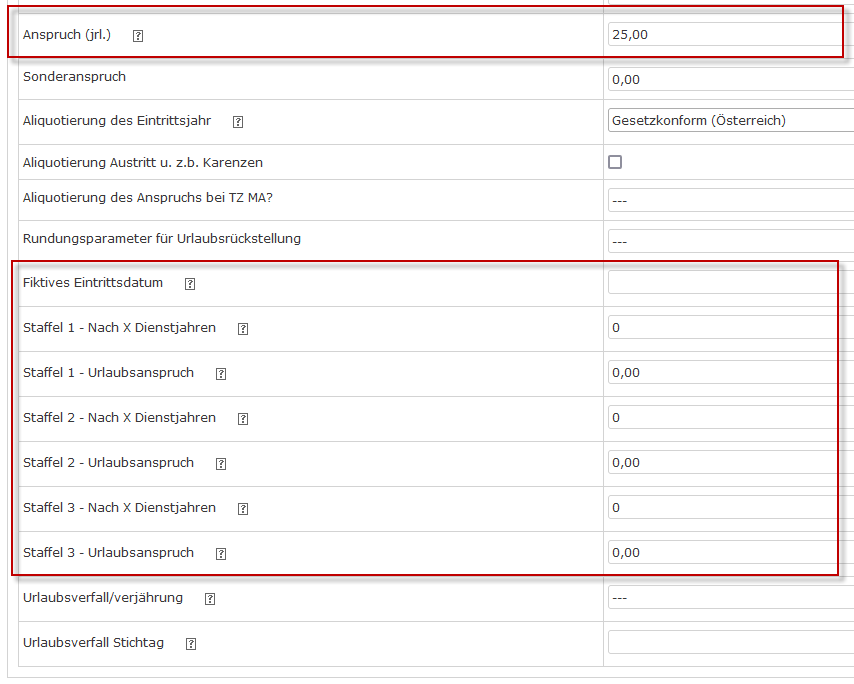
Fictitious hire date
The fictitious hire date is date is used to calculate the correct vacation entitlement in relation to years of service (according to the tier). Since a certain number of years of service, school or university periods can be credited, the fictitious hire date is calculated in order to determine the position in the tiering, regardless of the actual hire date. If no fictitious hire date is entered, no tier step will occur.
|
Value
|
Unit
|
|
Date
|
Day and month with two digits, year with four digits (DD.MM.YYYY)
|
Tiering point in time: Tier 1 - after X years of service
In Personalwolke it is possible to define up to 4 different vacation entitlement values per employee in a tiering. Here you can specify after how many creditable years of service the person moves up to tier 1 and is thus entitled to more vacation.
|
Value
|
Unit
|
|
Numeric value
|
Number of years of service from which tier 1 is active
|
Tiered entitlement: Tier 1 - vacation entitlement
Here you define the (increased) vacation entitlement provided for tier 1, in days per year. After the previously defined number of years of service has been completed, the vacation entitlement is automatically increased to this value.
|
Value
|
Unit
|
|
Numeric value
|
Vacation entitlement per year in tier 1
|
The settings for tiers 2 and 3 behave exactly the same as those for tier 1; in each case the number of required years of service and the new (increased) vacation entitlement are entered.
-------------------------
Example
A bank's collective agreement provides that the vacation entitlement is 30 days from the 20th year of service.
The entry looks like this:

The bank's collective agreement provides that periods of prior service at other banks are also to be included in these years of service.
Employee Charon joined the company in April 2022, but has already "brought along" 18 years of prior service at another banking institution. To guarantee her rightful vacation entitlement after 20 years of service, the fictitious hire date is therefore set so that, after completing 20 years of service (18 years of service with the previous employer + 2 years of service with the current employer), she actually gets 30 vacation days per year.
The following data is important for correct recording:
- Start of service with the previous employer
- End of service with the previous employer
- Creditable years of service with the previous employer (taking absences into account according to the collective agreement)
In the example, these are
- Start of service with the current employer: 04/01/2022
- Start of service with the previous employer: 03/01/2004
- End of service with the previous employer: 02/01/2022
- Period of service: 17 years, 1 month
- Deductions: 1 year, 1 month parental leave
- Creditable years of service at the end of service: 16 years
These 16 years must be taken into account when entering the fictitious hire date.
The fictitious hire date is therefore: 04/01/2006
Date from which the 20 years of service are completed: 04/01/2026

-------------------------
VACATION EXPIRATION
Vacation expiration cut-off date
If the option "Cut-off date, vacation expiration DE" was selected in the setting "Vacation expiration/statute of limitations" mentioned below, any cut-off date can be chosen here on which the remaining vacation entitlement of the past year is to expire.
|
Value
|
Description
|
Date
|
Format: DD.MM.YYYY - on this date (cut-off date), the remaining vacation of the previous year expires automatically
|
Vacation expiration/statute of limitations
According to the Austrian Vacation Act, an employee may carry over a maximum of 3 full annual vacation entitlements. If this threshold is exceeded, the oldest vacation entitlement expires after this time ("first in/first out" principle). Here you can define whether Personalwolke should carry out this rule automatically. In addition, in the case of earlier expiration of vacation days, a cut-off date (explained above) can also be defined.
|
Option
|
Description
|
|
Yes
|
If the threshold of 3 years is exceeded, the oldest remaining vacation carried over before this time expires
|
|
No
|
If the threshold of 3 years is exceeded, the excess remaining vacation does NOT expire automatically
|
|
Cut-off date, vacation expiration DE
|
The vacation entitlement from the previous year expires on the date selected under "Vacation accounting: Vacation expiration cut-off date"
|
-------------------------
Examples
-------------------------
Initial situation - variant vacation cut-off date Germany:
- On 12/31 the employee has (remaining) vacation of 5 days.
- On 1/1 the employee receives the new vacation of 25 days.
- The employee takes vacation from 2/3 to 2/5.
- The cut-off date for vacation expiration is 3/31.
|
Date
|
Vacation taken
|
Vacation current year
|
Vacation previous year
|
Vacation expiration
|
|
12/31
| |
5
|
0
|
0
|
|
01/01
| |
25
|
5
|
0
|
|
02/03
|
1
|
25
|
4
|
0
|
|
02/04
|
1
|
25
|
3
|
0
|
|
02/05
|
1
|
25
|
2
|
0
|
|
03/31
| |
25
|
0
|
2
|
The 3 vacation days in the current year are first deducted from the remaining vacation of the previous year, until it is used up. On the cut-off date (03/31), the unused remaining vacation from the previous year then expires. If a vacation day is requested on the cut-off date, it is still deducted from the remaining vacation before expiration (in relation to the example above, this means that if one more vacation day had been entered on 03/31, only 1 vacation day would have expired and not 2).
Keywords: vacation entitlement, vacation accounting, vacation days, tiered entitlement, prorated vacation entitlement, expiration of vacation entitlements

 erste


 Vergleiche Versionen 13 und 14
