Veränderungen des Inhalts
Klicken Sie für eine detaillierte Beschreibung auf die geänderten Stellen:
Benutzen sie die linke oder die rechte Maustaste, um zur jeweils vorherigen bzw. nachfolgenden Änderung zu gelangen.
The German tables used on this side will be substituted by English tables as soon as possible!
General
When
General
When does this correction entry become necessary?
1. When an employee switches from full-time to part-time or vice versa
2. When time tracking is activated for an employee who was already working at the company before (beyond the vacation allotment cut-off date)
When a new employee joins the company, it must be decided whether it should be possible to evaluate the aliquot prorated remaining vacation balance during the year. Similarly, it It may also be necessary to display the aliquot prorated remaining vacation when an employee leaves during the year. For these two cases, a logic has been implemented in the system , which that must be parameterized, as shown in the following examples.
InfoNote: If if no evaluation of the aliquot prorated remaining vacation balance is requiredneeded, the following steps do not have to be carried out.
The data input of the calculated values has to be done are entered via the correction client (to be found under Administration / - Time management). A detailed description of how to enter these values can be found at the end of this document.
Examples
: Entry in the correction client
Examples
Initial situation:
Start date of time recording tracking (creation of the user in Personalwolke): 01.07.2015 Effective date of leave February 1, 2024
Vacation cut-off date (date on which the annual leave vacation is credited): 01.12.
Example 1:

Explanation of table content:
Line 1 The remaining vacation (= vacation that the employee has not consumed) from 2014
every January 1
At the time time tracking starts for the employee, the employee has 5 remaining vacation days from the previous year (= unused vacation entitlement). As of January 1, 2023, 25 days were automatically added to the employee's vacation allotment. The total vacation entitlement is therefore 30 days (see the following table).
Example 1:By the time time tracking starts, the employee has already consumed 6 vacation days. These are now, on the one hand, applied to the remaining vacation of the previous year, and on the other hand, the consumption not covered by the remaining vacation is deducted from the vacation allotment of the current year.
That is, these 6 vacation days are covered by the 5 remaining vacation days from 2023 on the one hand, and on the other hand 1 day is already deducted from the new vacation allotment from 2024.
The remaining vacation from 2023 is therefore completely used up and 24 days of the entitlement from 2024 remain (see the following table).

Explanation of the table contents:
-
Row 1
The remaining vacation - that is, vacation the employee has not used up - from the year 2023 (previous year) is 5 days. These 5 days will be carried into It is carried over unchanged to the next year.
-
LineRow 2 - line Row 4
On effective date of leave (01.12.2014), the vacation cut-off date, here December 1, 2023, the new annual vacation / remaining vacation (25 days) is added to the remaining vacation from the previous year (5 days). This results in the total remaining leave of vacation (30 days).
-
LineRow 5 - line Row 8
On 01.07.2015, July 1, 2024, the employee had already taken 6 vacation days have already been consumed by the employee. Now the case is, when . When vacation days are usedconsumed, they are first deducted from the remaining vacation from the previous year before the current remaining vacation is reduced.
As shown in line row 1, there are 5 vacation days are left from the previous year. Line 9 - line After deducting the 6 vacation days taken, the remaining vacation previous year is used up and one day more was even consumed, which as a result has to be deducted from the remaining vacation of the current year.
-
Row 9 - Row 11
The current remaining vacation (25 days) is now reduced by the result remaining vacation from the previous year result. Since the result remaining leave vacation previous year result is negative ( in this case (-1)), the new balance on 01.07.2015 (on July 1, 2024) is 24 days.
-
LineRow 12
The number of days from 01.12.2014 to 01.07.2015 is 213.
Example 2:

Explanation of table content:
-
Line 1 The remaining vacation (= vacation that the employee has not consumed) from 2014 December 1, 2023 to July 1, 2024 is 214.
Example 2:
By the time time tracking starts, the employee has already consumed 4 vacation days. These are now applied to the remaining vacation of the previous year. Of the 5 remaining vacation days from 2023, 1 day is left. It is added to the new vacation allotment from 2024.
The employee therefore has 26 vacation days still available for the current year (see the following table).

Explanation of the table contents:
-
Row 1
The remaining vacation - that is, vacation the employee has not used up - from the year 2023 (previous year) is 5 days. These 5 days will be carried into It is carried over unchanged to the next year.
-
LineRow 2 - line Row 4
On effective date of leave (01.12.2014), the vacation cut-off date, here December 1, 2023, the new annual vacation / remaining vacation (25 days) is added to the remaining vacation from the previous year (5 days). This results in the total remaining leave of vacation (30 days).
-
LineRow 5 - line Row 8
On 01.07.2015, July 1, 2024, the employee had already taken 4 vacation days have already been consumed by the employee. Now the case is, when . When vacation days are usedconsumed, they are first deducted from the remaining vacation from the previous year before the current remaining vacation is reduced. As
As shown in line row 1, there are 5 vacation days are left from the previous year. Line 9 - line After deducting the 4 vacation days taken, 1 day of the remaining vacation of the previous year is left.
-
Row 9 - Row 11
The current remaining vacation (25 days) is now increased by the result of the remaining vacation from the previous year result. Since the result of the remaining leave from the remaining vacation previous year result is positive ( in this case (+1)), the new balance on 01.07.2015 (on July 1, 2024) is 26 days.
-
LineRow 12
The number of days from 01.12.2014 to 01.07.2015 is 213.
Example 3:

Explanation of table content:
-
Line 1 The remaining vacation (= vacation that the employee has not consumed) from 2014 December 1, 2023 to July 1, 2024 is 214.
Example 3:
By the time time tracking starts, the employee has already consumed 22 vacation days.
The 5 remaining vacation days from 2023 are used to cover them. 17 consumed days remain, which are deducted from the new vacation allotment from 2023.
At the time time tracking starts, the employee therefore has 8 days of remaining vacation left (see the following table)
These are now applied to the remaining vacation of the previous year. Of the 5 remaining vacation days from 2023, 1 day is left. It is added to the new vacation allotment from 2024.
The employee therefore has 26 vacation days still available for the current year (see the following table).

Explanation of the table contents:
-
Row 1
The remaining vacation - that is, vacation the employee has not used up - from the year 2023 (previous year) is 5 days. These 5 days will be carried into It is carried over unchanged to the next year.
-
LineRow 2 - line Row 4
On effective date of leave (01.12.2014), the vacation cut-off date, here December 1, 2023, the new annual vacation / remaining vacation (25 days) is added to the remaining vacation from the previous year (5 days). This results in the total remaining leave of vacation (30 days).
-
LineRow 5 - line Row 8
On 01.07.2015, July 1, 2024, the employee had already taken 22 vacation days have already been consumed by the employee. Now the case is, when . When vacation days are usedconsumed, they are first deducted from the remaining vacation from the previous year before the current remaining vacation is reduced. As
As shown in line row 1, there are 5 vacation days are left from the previous year. After deduction of After deducting the 22 consumed vacation days taken, the remaining vacation previous year is completely used up from the previous year. Line 9 -line and 17 days more were even consumed, which as a result have to be deducted from the remaining vacation of the current year.
-
Row 9 - Row 11
The current remaining vacation (25 days) is now reduced by the result remaining vacation previous year result. Since the result of remaining vacation previous year result is negative ( in this case (-17)), the new balance on 01.07.2015 (on July 1, 2024) is 8 days.
-
LineRow 12
The number of days from 01.12.2014 to 01.07.2015 is 213.
Input
-
December 1, 2023 to July 1, 2024 is 214.
Entry in the correction client
To enter the values calculated according to the above examples in the system, the following accounts must be corrected via the correction client.
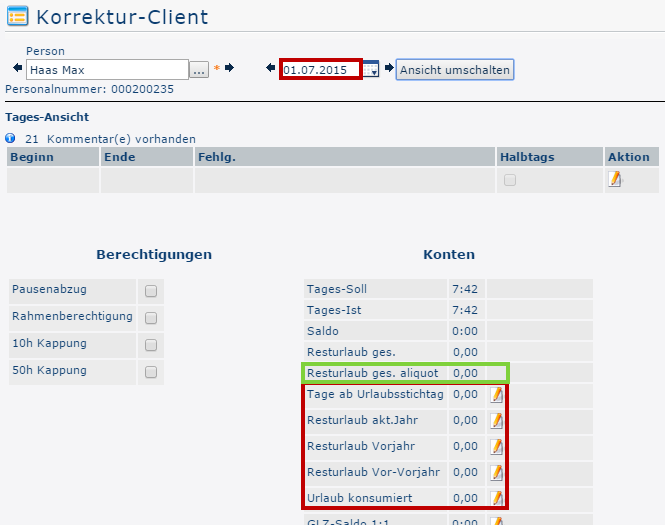
Remaining vacation (current year) With an absolute correction (=24), the number of open vacation days in the current year is entered. Remaining vacation (previous year)
 With an absolute correction (=0), the number of remaining vacation days from the previous year is entered here, which remain after deduction of the consumed vacation. If the result is negative, as in examples 1 and 3, no correction needs to be made here! Remaining vacation (pre-previous year)
 With an absolute correction (=0), the number of remaining vacation days from the pre-previous year is entered here, which remain after deduction of the consumed vacation. If the result is negative, no correction needs to be made here! Vacation consumed
 With an absolute correction (=0), the number of vacations day is entered, that the employee has already consumed since the last effective date of vacation.
The calculated aliquot remaining vacation is displayed from the following correction day (02.07.) in the line "Resturlaub ges. aliquot" (marked in green How is the entry made?
The correction client is designed so that all entries regarding vacation always refer to the year in which the date selected above falls.
That means that if you want to change the remaining vacation figure for the year 2024, a date (the year-end) of the year 2024 must be selected.
This has the advantage that it is possible to specify the remaining vacation precisely as of a cut-off date.

The correction is made by editing the field "Remaining vacation current year" (red arrow). Clicking the edit icon (pencil) enables entry.

Using an absolute correction (=24), you enter here the number of vacation days the employee is still entitled to in the current year. This value is highlighted in light blue in the respective tables of the examples (row 11). How this number is arrived at is discussed in the three examples above under the respective items "Row 9 - Row 11".
The calculated prorated remaining vacation is displayed from the day after the correction in the row Total remaining vacation prorated (green arrow).

 erste


 Vergleiche Versionen 3 und 4

