Germany: Time tracking is mandatory

New contributions:
Experience the future of corporate management: let your employees manage their own data with Employee Self Service!
Why is trust-based working time so controversial? In this blog, we will tell you what trust-based working hours really mean, what opportunities and risks they entail and which legal regulations employees and employers must observe.
Trust-based working hours: flexibility or control and transparency through time tracking?
Why is trust-based working time so controversial? In this blog, we will tell you what trust-based working hours really mean, what opportunities and risks they entail and which legal regulations employees and employers must observe.
With Resolution from 13.09.2022 the Federal Labor Court (BAG) has ruled on the obligation to systematically record working hours. This means that employers are now obliged to operate a system that records employees' working hours. If such a system does not yet exist, it must be introduced in accordance with Section 3 (2) No. 1 of the Occupational Health and Safety Act (ArbSchG).
But is this really the case? We want to get to the bottom of this hysteria.
Why is it important to record working hours?
Although the European Court of Justice issued a ruling on the mandatory recording of working hours back in 2019, the conversion into German law has been a long time coming. The recent ruling could therefore have a huge impact on all players in the German labor market.
Often the term „Working time recording“ is associated with uncertainty and primarily triggers negative feelings. Quite wrongly, recording working hours offers numerous advantages for both employees and employers. Employees have a transparent insight into the hours worked at all times and can therefore plan ahead better and prevent overtime. Keeping to the agreed working hours also ensures sufficient rest periods and thus prevents overwork and burn-outs.
However, regulated working time recording also has positive benefits for employers. This gives management a better overview of the hours worked and internal resource allocation can be optimally managed. In addition, compliance with the legal framework is guaranteed and employers are always on the safe side legally.
All these points make it clear that a legal obligation to record working time not only makes sense, but can benefit both employers and employees.
What should companies do now?
Even if the ruling of the Federal Labor Court (BAG) seems very drastic at first glance, companies still have a lot of decision-making power when it comes to internal implementation. The main focus of the ruling is on employee protection and therefore on compliance with the legally defined maximum working and rest times. Provided there is an objective, reliable record that is accessible to all parties involved, it is up to the companies themselves to decide how this record is kept, as there is still no legal regulation on this.
Although the legislator has not yet set a deadline for the introduction of working time recording, companies would be well advised to address the issue now. This way, the company does not run the risk of waiting until the actual legal ruling and then being forced to implement it hastily. As already mentioned, companies can benefit from successful working time recording, but there are a few things to consider when choosing the right method.
Time recording systems are industry-specific features with regard to the company structure and the working time model. In order to find the right system here, the individual circumstances of the company must be considered in detail. Our experienced product experts offer professional advice and respond to individual requirements.
The role of the works council
Similarly, the role of the works council in deciding on the recording of working hours has not changed as a result of the BAG ruling. Thus, although the works council cannot decide on the introduction of a working time recording system, the Right of co-determination The question of the form of implementation remains. There is a wide range of options, from the classic time clock to electronic time recording and manual Excel lists. This makes it clear that the interests of employee representatives should not be disregarded when selecting a time recording system.
With Personalwolke, you can rely on software that meets all the key requirements of employee representatives and therefore also satisfies the works council and your employees.
Working time recording with personnel cloud
With Personalwolke, you can record working times easily and systematically. The system reliably helps you to automatically comply with statutory obligations. In addition, Personalwolke can be optimally adapted to current internal and external circumstances, such as new company agreements, changes in legislation and much more, and can be expanded step by step. Thanks to its modular structure, this flexibility is also reflected in the price.
You can get off to a perfect start with simple absence management and the recording of home office days. If the law requires it, or if you want positive time recording in combination with flexitime models or shift models, this is of course possible immediately.
Your advantages
- Digital working time recording via computer, smartphone, (web) app, time recording terminal
- Simple vacation and absence management
- Digital applications & user-defined approval workflows
- 100% GDPR compliant
Digital time recording for German companies
German employment law is very extensive and complex. We specialize in this market and know the legal and statutory framework conditions.
Our many years of experience in the field of time recording will give you a head start.
Act proactively now and put your trust in us.
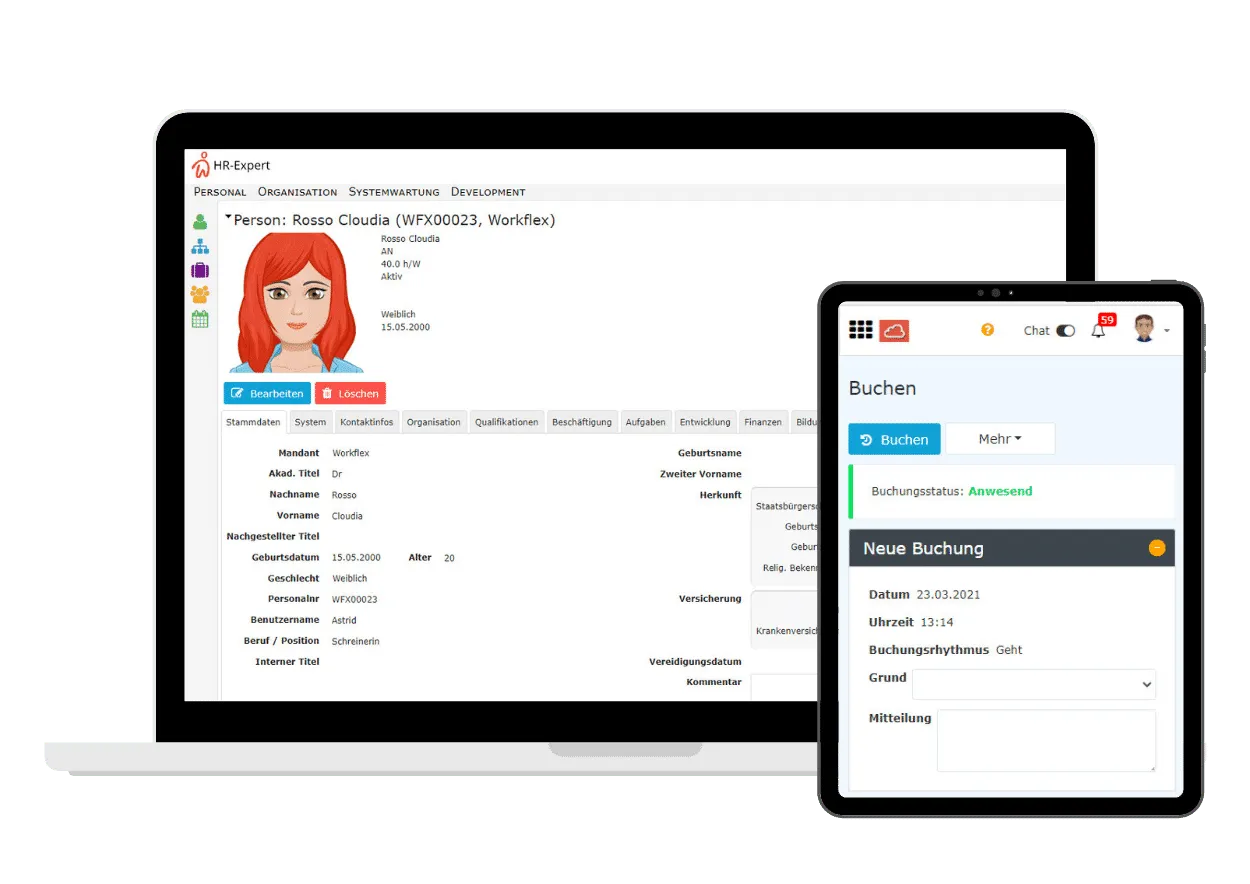
Would you like to know how you can quickly and easily introduce digital time recording in your company?
Arrange a free consultation now and we will get back to you shortly.

